First Coast Tree Field Guide
A Field Guide to Jacksonville's Trees
By Jordan Hale
Jacksonville sits where coastal Florida meets the mouth of the St. Johns River, so the canopy runs from ancient live oaks and cabbage palms to fast pines and the laurel oaks that fill out so many yards.
Knowing the species explains what you're seeing — and what to expect in a storm. A live oak's strength, a laurel oak's short life, a palm's real pruning needs, and a pine's wind behavior each lead to different care.
This is a homeowner field guide, not a botanical key. When health or structure is in doubt, pair identification with an arborist assessment.
Trees That Define the First Coast Canopy
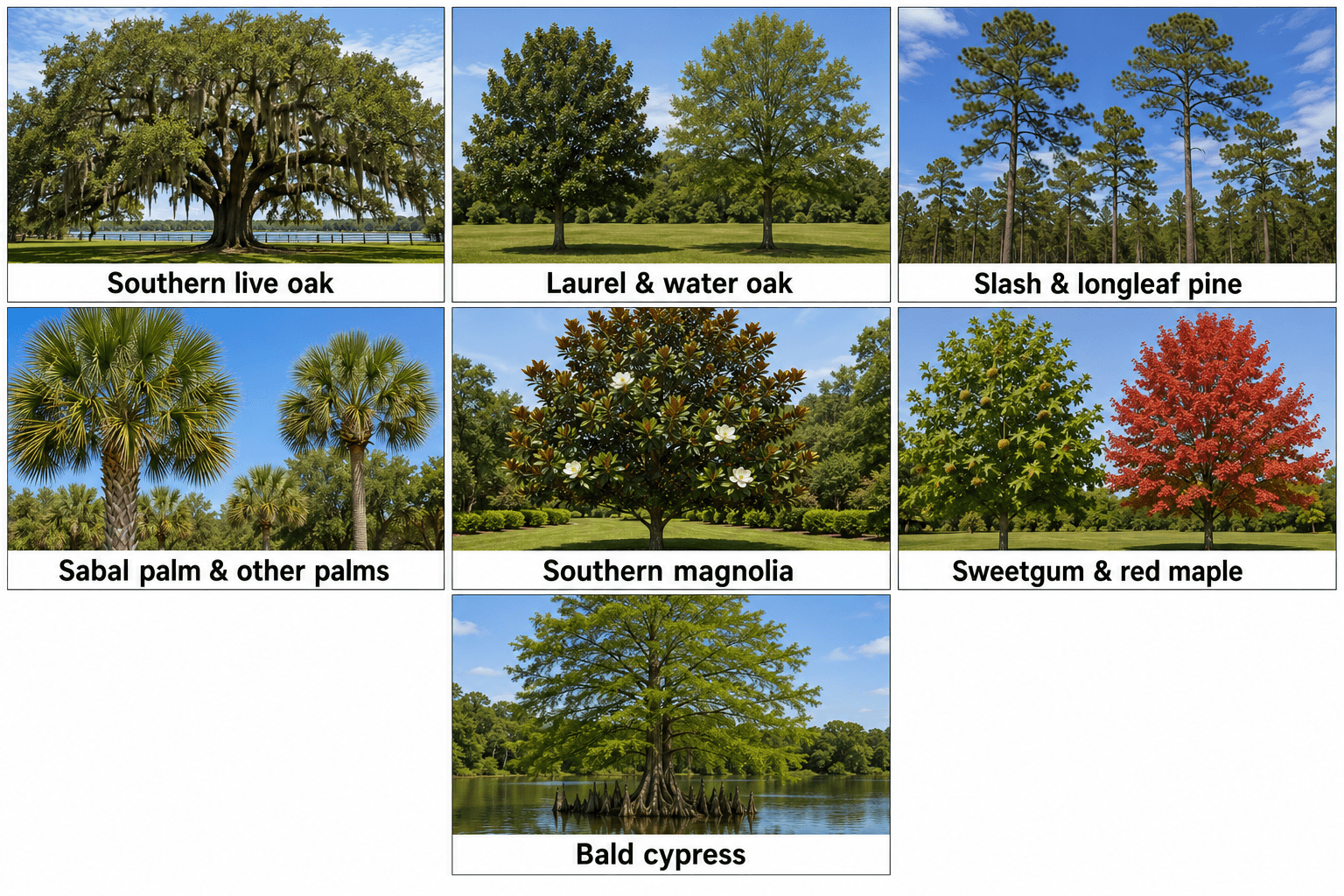
These species show up again and again from historic Jacksonville to the Beaches and down toward St. Augustine.
Southern live oak
The signature First Coast tree — massive, long-lived, and famously wind-firm, often draped in Spanish moss. Worth protecting with structural pruning and clearance, never topping.
Laurel & water oak
Fast-growing and everywhere, but short-lived and prone to internal decay. These are the classic storm casualties — worth inspecting early and cabling or reducing before a union tears.
Slash & longleaf pine
Tall coastal pines common on larger lots. Watch for fresh lean and root movement after tropical rain, and snapped tops after high wind. Thinning nearby competition can help them stand.
Sabal palm & other palms
The sabal (cabbage) palm is Florida's state tree. Palms need light pruning — dead fronds and seed stalks only. The over-cut 'hurricane trim' weakens them; it doesn't help.
Southern magnolia
Glossy evergreen leaves and big white blooms, with heavy low limbs that benefit from thoughtful clearance. Prefers a protected root zone and light, selective pruning.
Sweetgum & red maple
Common natives in yards and wetter spots. Sweetgum's spiky balls and star leaves and maple's opposite branching are the tells. Early structural pruning heads off crowded, competing stems.
Bald cypress
A water-loving native along the St. Johns and area ponds, with feathery foliage and 'knees' at the base. Tough and storm-resilient, it rarely needs more than deadwood cleanup.
Identification Changes the Care Plan
Species drives mature size, lifespan, decay patterns, wind behavior, pruning tolerance, and the season when work stresses the tree least.
It also sets what counts as normal. Spanish moss isn't a disease, surface roots can be a trait, and a laurel oak simply won't live as long as the live oak beside it.
Before heavy pruning, check the tree against our Jacksonville pruning calendar. If structure or health is uncertain, run through the hazard checklist.
Photograph the Clues That Matter
For ID, capture the whole tree, the branching pattern, bark, leaves or fronds, any fruit or cones, and buds when you can.
Include the site. Soil, drainage, salt exposure, root space, and nearby construction often explain condition better than a single leaf close-up.
Send those with your project details and we can point you toward pruning, monitoring, or the right service.
Jacksonville Tree Identification Questions
What's the most iconic tree in Jacksonville?
The Southern live oak — Jacksonville's own Treaty Oak is estimated at 250-plus years old. Live oaks, laurel and water oaks, sabal palms, slash pines, and magnolias fill out the rest of the First Coast canopy.
Is Spanish moss killing my tree?
No. Spanish moss is an epiphyte — it just hangs on the branches and doesn't feed on the tree. Heavy moss can shade interior growth, but it isn't a disease and rarely needs removal.
Why do so many Jacksonville oaks fail in storms?
Many are laurel or water oaks, which grow fast, hollow out early, and don't live as long as live oaks. Aging specimens are worth inspecting and often cabling or reducing before storm season.
How should palms be handled?
Lightly. Remove only dead fronds and seed stalks and leave the healthy green ones. Over-pruning a palm — the so-called hurricane cut — stresses and weakens it.
Keep reading
Related guides & services
Useful next steps from Jacksonville Tree Co. across Jacksonville.
Need Help Reading Your Trees?
Send photos of the tree and whatever's got your attention.
We can help narrow the species and recommend tree trimming, an arborist assessment, or removal when it's warranted.